


Reducing Memory Overhead in Valkey 9.1
Valkey 9.1 introduces three optimizations that reduce the per-key memory overhead without requiring any new commands or configuration changes.
These reduce the memory required to store strings and sorted sets, up to 44% overhead for string keys and up to 8.5 bytes per sorted set member for typical short members. These savings add up quickly when millions of keys are in use.
This blog post explores how these optimizations work and what they mean for your real-world deployments.
The Cost of Internal Recordkeeping
In Valkey, the values live inside an robj, a ref-counted object.
Valkey does not store every value of a given type the same way internally. Depending on its size and structure, the same logical string or sorted set can be represented in memory using different physical layouts. Valkey calls these layouts encodings, and you can check which encoding a key is using at any time with OBJECT ENCODING:
> OBJECT ENCODING key
"embstr"
Choosing the right encoding based on a value's size helps Valkey balance memory use and performance.
One such encoding is embstr, the optimized memory encoding for small strings. Instead of storing the string data as a separate allocation, the string is placed immediately after the robj header in the same contiguous block of memory. The simplified layout before Valkey 9.1:

This structure represents not only your data, but also metadata, flags, reference counts, and a pointer (ptr) to the actual value. For raw encoding, where the string lives in a separate allocation elsewhere in memory, that pointer is necessary. But embstr encoding guarantees the string sits immediately after the robj header, always in the same fixed offset, so its location is always computable. Storing a pointer to something you can always compute is redundant.
Eliminating the Redundant Pointer
After the changes in Valkey 9.1, the ptr field is removed from the embedded string layout by reusing its 8-byte slot to store the beginning of the embedded string itself. Because the string's location is deterministic, Valkey now computes its address on demand using pointer arithmetic instead of storing an explicit pointer. The new layout looks like this:

The result is that every value stored with embstr encoding shrinks by 8 bytes at the struct level. Whether that translates into a real memory saving depends on jemalloc's allocation rounding, more on that below.
Raising the embstr Threshold from 64 to 128 Bytes
Removing this redundant pointer reduced the size of every embedded string object. Because the robj header itself got smaller, this means the same total allocation budget now accommodates more actual string content.

Raising this threshold to 128 bytes (covering the full robj size including key, expiry metadata, and value) means more string sizes now qualify for the more compact embstr layout instead of falling through the raw encoding.

Any key returning embstr benefits from both of the above optimizations with no extra configuration required.
The saving per key is not a flat number. Because Valkey allocates memory through jemalloc, requests are rounded up to fixed size classes rather than granting the exact byte count requested. In practice this produces overhead reductions ranging from roughly 17% to 44%, averaging around 26%.
(Note: Measured across a range of key+value sizes, 5 million items per test, Valkey 9.0 compared to 9.1.)
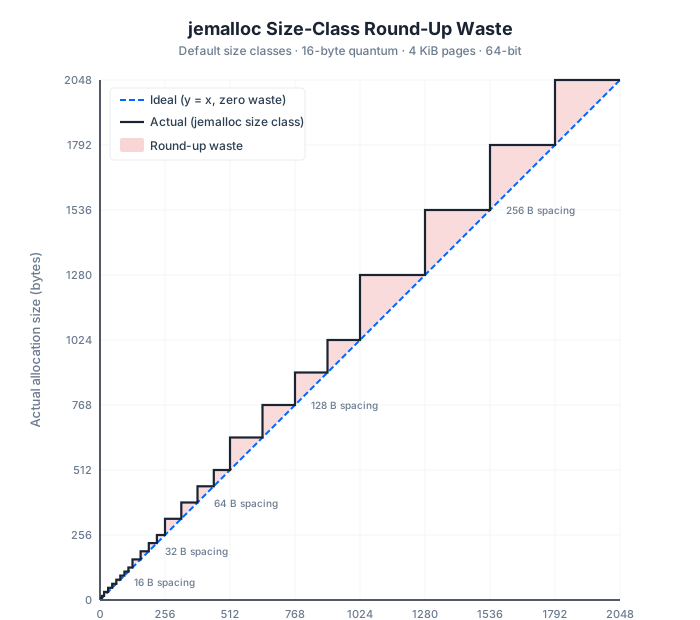
The exact saving depends on where your key+value sizes fall relative to jemalloc's size class boundaries.
Optimizing Sorted Sets to Reduce Overhead
The final improvement in Valkey 9.1 targets Sorted Sets, where the sets also received a memory reduction for workloads that use the skiplist encoding representation.
In the default configuration, once a sorted set grows beyond 128 elements, or if a single member exceeds 64 bytes (the default thresholds), Valkey stores it internally using the skiplist encoding. Before Valkey 9.1, each skiplist node contained a pointer to a separately allocated SDS string representing the member.

Note: SDS (Simple Dynamic String) is Valkey's internal dynamic string implementation. Most keys, string values, and many internal data structures are stored as SDS objects.
Sorted set members are typically short and immutable. Once a member is added to a sorted set, its value never changes in place, so there is no risk of the embedded string needing to grow and disrupt a node's layout later. Because the embedded data now sits at the end of the allocation, it does not shift the position of the other fields (score, backward pointer) that the rest of the skiplist logic depends upon.
In Valkey 9.1, the SDS representation is embedded directly inside the skiplist node instead of being stored as a separate pointer:

The actual saving depends on member length, for the same reason string savings varied earlier: merging the separate member allocation into the skiplist node changes how jemalloc rounds the resulting allocation size. For typical short members (10-40 bytes), 9.1 saves roughly 6-8.5 bytes per member which is about 11-15% of per-member overhead. A handful of specific lengths see little or no benefit, and a few see a small regression, so the real number for your workload depends on your actual member sizes.
Quantifying the Impact
The above improvements effectiveness vary by workload, key sizes and data type mixes. However, as a practical reference:
| Change | Affected encoding | Struct-level change | Measured overhead reduction |
|---|---|---|---|
Remove robj->ptr | embstr strings | -8 bytes | 17-44% (avg. 26%) |
Raise embstr threshold to 128 bytes | Objects newly eligible under the raised threshold | -8 bytes (newly applies) | included in range above |
| Embed element SDS inside skiplist node | Sorted set members (skiplist encoding) | -8.5 bytes (max) | 11-15% for members 10-40B |
What This Means for Production
These improvements are transparent and you do not need to change your configuration, commands, or application code. The savings activate automatically on upgrade to Valkey 9.1.
For clusters that are operating near memory limits, these no configuration required reductions may bring you back into having a comfortable headroom. However the impact is most pronounced for workloads dominated by small strings or large sorted sets.
If you are utilizing Valkey as a dedicated cache running near full capacity with an eviction policy such as allkeys-lru, these memory savings effectively increase your cache capacity. With more data fitting into the same amount of memory, your cache may achieve a higher hit rate without requiring any changes.
Try This Against Your Own Workload
None of the above matters until you check it against real keys. Here's how to find out what Valkey 9.1 is worth to you specifically.
Pick a handful of representative keys from your production deployment and run MEMORY USAGE and OBJECT ENCODING on a 9.0 instance versus a 9.1 instance where MEMORY USAGE gives you the byte count, OBJECT ENCODING tells you which layout produced it:
> MEMORY USAGE session:abc123
> OBJECT ENCODING session:abc123
A key converts from raw to embstr once its combined key+expiry+value size falls within the new 128-byte budget. A restart alone is enough to trigger it, since RDB and AOF reload re-applies encoding logic. If a key reports embstr where it used to report raw, that key just got cheaper to store. Multiply the byte difference by your key count and you have the real number, not just an estimate.
For sorted sets, the savings depend on your member lengths where short members (10 to 40 bytes) see the most benefit, roughly 11-15% of per-member overhead. Compare MEMORY USAGE on a representative sorted set before and after upgrading to see what your actual member sizes yield, since the exact number varies by length in the same allocator-rounding way string savings do.
The memory you get back by simply moving to 9.1 and measuring what has changed is the real upgrade.
 Slack
Slack
 GitHub
 LinkedIn
 X.com
X.com
 YouTube
 Connect
